


Markets have treated all software as a loser from artificial intelligence. We think that is too blunt, and it is why software remains a meaningful part of both PPM portfolios.
KEY POINTS
- AI fears drove a sharp, largely indiscriminate sell-off in software stocks while semiconductors rallied.
- We separate software that merely assists a workflow from software that controls it, holds proprietary data and is costly to replace.
- Software is about an eighth of both PPM portfolios. As always, the price you pay matters most.
Over the past year artificial intelligence has encouraged investors to divide the technology sector into winners and losers. Semiconductor manufacturers, data centre equipment suppliers and the large cloud companies have benefited from enormous spending on computing infrastructure. Software companies have had a harder time.
Software and semiconductors part ways
S&P 500 Software and Semiconductor indices, % change, 4 November 2025 to 30 June 2026
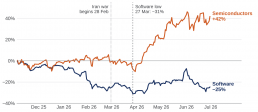
Source: Bloomberg, 4 Nov 2025 – 30 Jun 2026.
From early November to late March, the S&P 500 Software Index fell 31% while the Semiconductor Index slipped only about 8%. From the March low to the end of June, the Semiconductor Index rose more than 50%, while the Software Index recovered only around 9%.
Software is not one industry
The argument is simple enough: if AI can write code, automate workflows and perform tasks previously completed by people, then some of the software used by those people must become less valuable.
The problem is that “software” is not one industry. An application that performs a narrow task and can be replaced in an afternoon is very different from software that runs the financial accounts, supply chain, tax records or logistics operations of a multinational company. We think the market has been too quick to treat them the same.
One distinction we find useful is whether the software merely assists a workflow or actually controls it. SAP’s enterprise resource planning systems sit at the centre of finance, procurement, inventory, manufacturing and human resources for many of the world’s largest organisations. Replacing them can involve years of work, very large implementation costs and retraining thousands of employees. WiseTech’s CargoWise platform occupies a similar position within global logistics, while accounting platforms such as Intuit and Xero also benefit, to varying degrees, from sitting inside financial records, tax, payroll and payments.
None of this means these companies cannot be disrupted. It does mean that disruption is likely to be more difficult than is sometimes suggested.
The incumbent already has the data
AI needs data and context. A generic model may be able to produce an invoice, but it still needs to know which customer, product, accounting rule and approval process applies. The incumbent software company often already has that information.
SAP’s recent results are a useful example. Despite widespread concern that AI could undermine traditional application software, cloud revenue continued to grow strongly and free cash flow rose 36% in the September quarter. That does not look like a business being rapidly displaced. Intuit’s operating cash flow rose 42% in its 2026 financial year.
Of course, some software will be disrupted. Smaller point solutions with limited proprietary data and low switching costs are probably the most exposed, as are businesses that rely heavily on per-seat pricing. The point is not that software is safe from AI. It is that the effect will not be uniform.
Valuation, and closer to home
The best investment opportunities rarely appear when everybody is comfortable with the outlook. SAP had been a company we admired for some time, but historically its valuation made it difficult to earn an adequate return. The fall in software valuations changed that equation and we added to our holding in the Global portfolio through July and August.
Xero and WiseTech were significant detractors from the Australian portfolio in September. WiseTech has had genuine governance and execution issues, and those risks should not be ignored. But a falling share price and a deteriorating business are not necessarily the same thing.
Where this sits in PPM portfolios
Software makes up about an eighth of both our Global and Australian portfolios, and we think every company we hold there passes the test above: it controls the workflow rather than merely assisting it.
Neither portfolio holds the smaller, single-purpose software businesses, or those most reliant on per-seat pricing, that we think are most exposed to AI.
Global portfolio
Microsoft · SAP · Intuit
Australian portfolio
WiseTech · Xero
Holdings as at 31 October 2026.
The challenge for investors is therefore not to decide whether “software” wins or loses from artificial intelligence. It is to work out which companies own important workflows, have durable data and customer relationships, and are still earning good returns on the capital being invested.
Then there is the final question, which is usually the most important one: what price are you paying?
Technology changes quickly. Investment arithmetic does not.
For further information on Private Portfolio Managers and our Managed Accounts offering please contact us:

JILL MAY
Head of Client Relations
M: 0412 033 359
P: (02) 8256 3777
Email: jm@ppmfunds.com

WARREN JONES
Head of Financial Adviser Distribution
M: 0422 819 116
P: (02) 8256 3777
Email: wj@ppmfunds.com

JONATHAN GERSHUNY
Head of Professional Services Distribution
M: 0424 890 926
P: (02) 8256 3777
Email: jgershuny@ppmfunds.com